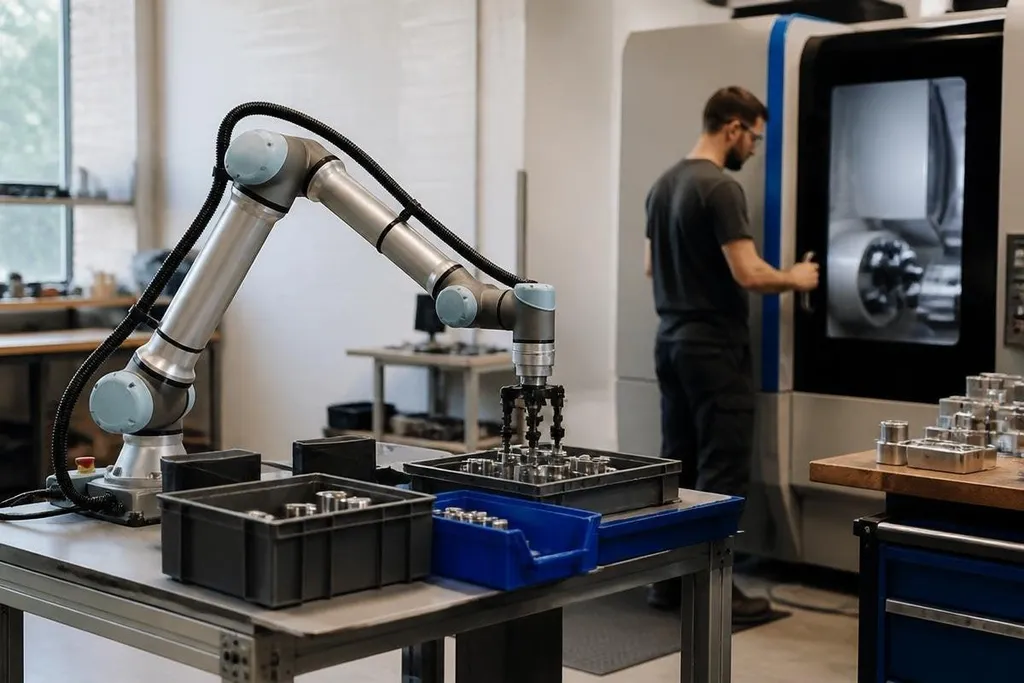
Small companies don't need a robot fleet to gain from automation. The safer starting point is one repeated task where the work, handoff, and result are easy to measure.
- Start with a task that repeats every day
- Match the robot to the load, reach, and workspace
- Count setup, service, training, and safety work
Find the task before the robot
The best first task is usually steady, physical work that ties up a person’s time. Moving parts between workstations, loading a machine, checking a fixed area, or placing items into boxes can fit this pattern.
The steps need to stay similar. A robot arm works from programmed positions, while a mobile robot uses sensors and maps to move through a work area. If the task changes with every order, the company may spend more time correcting the robot than doing useful work.
Watch the task across a full work period before choosing equipment. Record the object’s size and weight, the handoff point, the reach needed, and the time lost when the process stops. Those details give a robot maker something real to design around.
Pick the machine around the work
A factory may need a collaborative robot, often called a cobot. It can work near people when the full setup meets the required safety rules, though its speed and force still need careful checks. A faster industrial arm may fit a guarded area better.
A shop with long walking routes may need a mobile robot instead. Its job could be moving bins between a storage area and a work cell. The floor must stay clear enough for sensors to detect people, pallets, and other obstacles.
The gripper matters as much as the arm. A two-finger gripper may hold a rigid part well, while soft or uneven objects may need a different tool. The machine also needs a safe place to stop during a jam, power loss, or person entering the work zone.
A small-business owner can use reports on working robots to compare a robot claim with a named company and work site. The next step is counting the labor, floor space, and support the system needs.
Count the work around the robot
The purchase price tells only part of the story. A small business may also need electrical work, floor changes, guarding, software setup, staff training, spare parts, and service visits. Someone must own the daily checks and decide what happens when the robot stops.
This is where many plans become too broad. A robot that runs one repeatable step can be useful, but a robot that needs a person to fix every handoff may add a new job instead of removing one.
Ask the maker to show the full task. The demo should include the real part, the real container, the normal lighting, and a recovery after a failed pick. A short clip with ideal objects says little about a mixed work area.
The open question is capacity. Can the robot keep working during the hours that matter, or does it need frequent pauses for charging, checks, or part refills? The answer depends on the task and the setup, so a written plan matters more than a broad product label.
A practical buying checklist
Use these checks before signing an order:
- Name one task: Write every step, including pickup, handoffs, and drop-off.
- Measure the load: Record weight, shape, surface, and how the part arrives.
- Mark the workspace: Show reach, floor routes, doors, people, and safe stop points.
- Price the support: Add training, guarding, software, service, spare parts, and power work.
- Test the failure: Ask what the system does after a missed pick, blocked route, or empty bin.
- Set a review date: Compare planned results with actual stops, repair time, and staff time.
I'd start with the task that has the clearest handoff, not the robot with the longest feature list.
One controlled work cell can give a small business enough information to decide the next step. If the robot keeps the task steady and the support work stays manageable, a second task has a reason to exist. If it doesn't, the company has limited the cost of finding out.